.png)
.svg)




Nearly 8 years ago, as a Tech Lead at AppDynamics (later acquired by Cisco), I took a very calculated yet unconventional decision to adopt Kubernetes to run our microservices.
The project’s infancy and complexity deterred many from implementing it.
However, I recognized the need to transition from a monolith to microservices to scale our platform for large enterprises. Kubernetes emerged as the optimal solution for managing these containerized services across various VMs and applications.
Fortunately, my talented team of engineers implemented it correctly, leading to a substantial boost to the bottom line as efficiently managed microservices enabled us to provide a cost-effective SaaS service.
Today, Kubernetes is widely adopted, with 78% of companies using it to manage containerized applications.
Despite its benefits, some tech leaders remain hesitant due to the complexity of Kubernetes implementations.
However, when executed correctly, Kubernetes delivers significant returns, not just through automatic container management but also by accelerating API security initiatives.
This blog covers how Kubernetes can help ease the burden on your DevSecOps team and help you secure your APIs easier and faster.
TL;DR
78% of companies use Kubernetes to manage containerized applications, and it directly accelerates API security. Kubernetes automates gateway deployment, simplifies service mesh integration, enforces network policies, and streamlines RBAC across dynamic microservices environments. When implemented correctly, it reduces misconfiguration risk, prevents unauthorized access, and gives DevSecOps teams a faster, more reliable security foundation.
Faster Deployment of API Gateways
API Gateways are indispensable for securing and managing your microservices, acting as the front line between your client applications and backend services. They handle critical functions like request routing, load balancing, and enforcing security policies.
Yet the sheer volume of APIs and the necessity to ensure consistent security across multiple endpoints make the deployment process cumbersome. Configuration complexity across the microservices architecture only adds to the deployment difficulty. As even a single misconfiguration could lead to service disruptions or worse data breaches.
And how about integrating legacy systems into the gateways?
All of these need to be solved while maintaining compliance with regulatory requirements.
And Kubernetes does exactly that!
It simplifies and automates the entire configuration process so that Gateways are consistently and securely deployed across all environments without you having to worry about misconfigurations.
By codifying and locking down your Kubernetes configurations, you ensure that services stay private by default. You don’t need to expose public IPs for your nodes either. Instead, external access can be managed through load balancers and ingress controllers.
Ingress controllers within Kubernetes handle routing, SSL termination, and load balancing automatically, allowing you to deploy Gateways at record speed.
Even if you are not ready to invest in a paid tool, free or community editions like Kong Community Edition or Nginx are great starters as they automate crucial tasks like rate limiting, authentication, and enforcing security policies.
Smoother Deployment of Service Meshes
A Service Mesh is essential for managing and securing microservice communication. Operating through a centralized control plane and proxies, it simplifies integration and deployment for your developers.
For your security team, it offers mTLS encryption, fine-grained access control, and deep visibility into service interactions, preventing unauthorized access to APIs.
However, deploying a Service Mesh in large-scale enterprise environments is complex due to the high number of microservices while minimizing performance overhead. Operational overhead, including monitoring, updating, and tuning, demands dedicated resources and expertise.
These challenges can lead to service disruptions, security vulnerabilities, and increased costs if not handled properly.
Kubernetes alleviates these challenges by seamlessly integrating with Service Mesh frameworks like Istio, Linkerd, and Consul.
Its declarative configuration approach simplifies policy and configuration management, reducing errors. Its optimized networking model also minimizes performance overhead, while features like horizontal pod autoscaling ensure efficient scaling of your Service Mesh.
Deploying a Service Mesh is not without its cost or complexity, but Kubernetes makes it more manageable and effective.
Organizations, especially those in finance or other security-sensitive sectors, must invest in a Service Mesh due to the high stakes involved.
Despite the challenges and costs, the benefits - such as improved security posture and simplified microservice management - often outweigh the drawbacks, especially when implemented alongside Kubernetes.
Prevent Unauthorized Access with Kubernetes Network Policy
Controlling which services can communicate is crucial in a containerized environment to prevent unauthorized access and data breaches.
Yet, managing API traffic is challenging due to numerous communication paths and the dynamic nature of containerized applications. Traditional firewalls, which rely on IP addresses and ports, are inadequate for modern, distributed architectures where services continuously change and scale.
Kubernetes addresses this with Network Policies. These policies allow you to define rules that control traffic between pods and namespaces based on labels and namespaces.
By specifying allowed interactions at the application level, Kubernetes offers a more effective solution than traditional network controls, reducing the risk of unauthorized access and a subsequent data breach.
Seamlessly Enforce RBAC
By restricting access based on roles, RBAC prevents unauthorized access and subsequent breaches.
However, enforcing RBAC is challenging not just due to the numerous microservices but also due to its dynamic nature. Maintaining RBAC configurations becomes incredibly difficult as services frequently scale and update.
Additionally, decentralized environments require RBAC to be manually managed across multiple systems, increasing the risk of misconfigurations. Integrating legacy systems with modern RBAC principles further complicates this, as significant adjustments are often needed to align old systems with new security standards.
Kubernetes RBAC Primer simplifies this as Roles and ClusterRoles define permissions, while RoleBindings and ClusterRoleBindings assign these roles.
Roles are scoped to specific namespaces, whereas ClusterRoles apply across the cluster.
This approach allows precise control over access, ensuring users and services have necessary permissions without excess privileges.
Automated API Security Platform Levo.ai
Here’s how we build on Kubernetes’ strengths: Imagine you have 100 microservices running in Kubernetes. Levo precisely identifies which API belongs to which microservice.
Our advanced sensors map these APIs directly to the corresponding microservices, and we extend this mapping to the code repositories.
By linking APIs to their repositories, we can determine which engineers authored them.
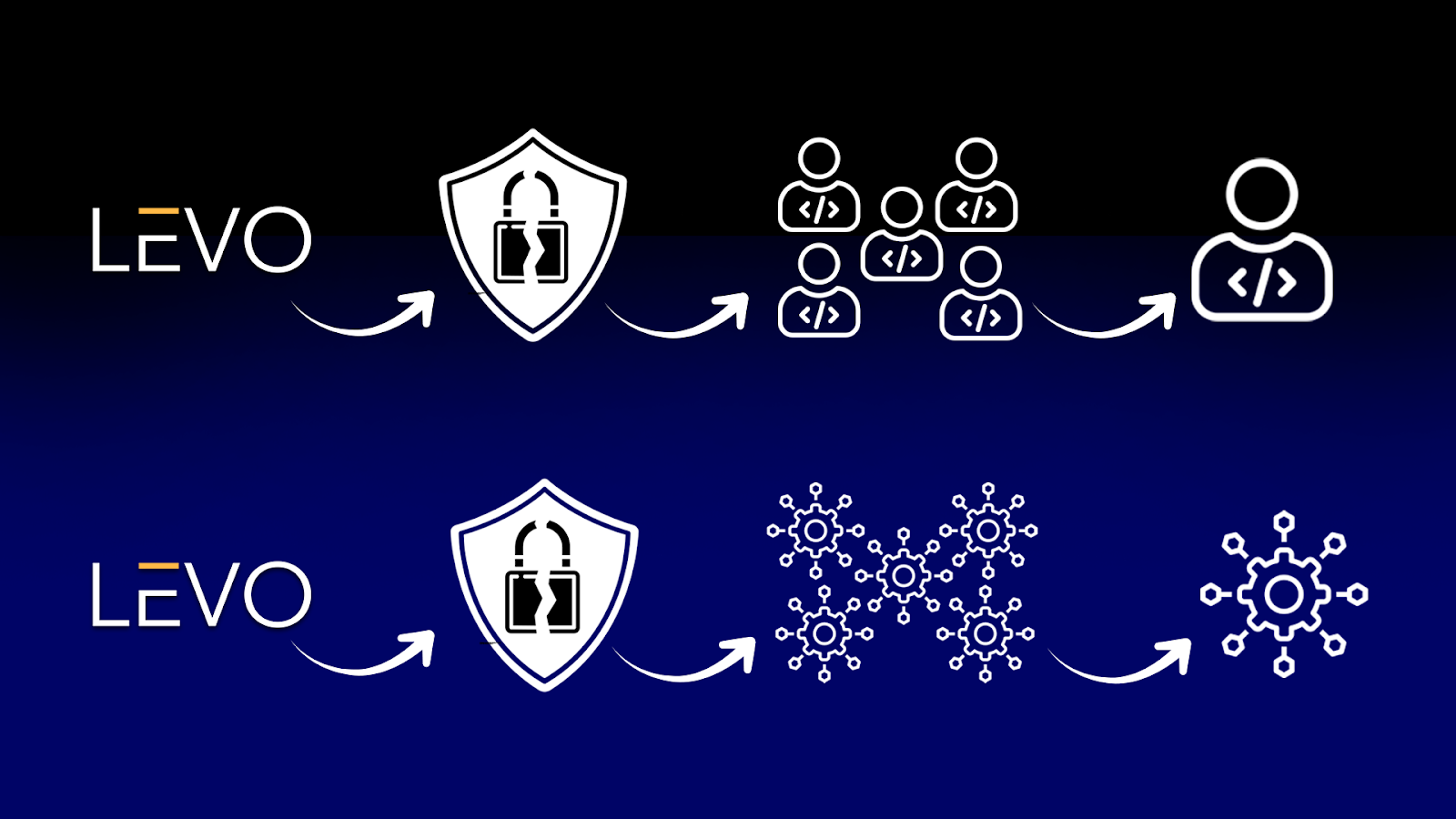
This feature ties ownership back to the development team, ensuring the timely remediation of discovered vulnerabilities.
Book a demo through this link to see this in action!
Conclusion
Kubernetes does more than manage containers. It removes the operational complexity that slows API security down, from gateway deployment and service mesh integration to network policies and RBAC enforcement.
Levo.ai builds on that foundation by precisely mapping every API to its corresponding microservice, code repository, and owning engineer, ensuring vulnerabilities are not just discovered but routed to the right team for fast, accountable remediation.
FAQs
How does Kubernetes improve API gateway deployment?
It automates configuration, handles SSL termination, load balancing, and ingress routing, and ensures gateways are consistently deployed across all environments without manual misconfiguration risk.
What is a service mesh and why does Kubernetes make it easier?
A service mesh manages and secures microservice communication via mTLS, access controls, and traffic visibility. Kubernetes simplifies deployment through native integration with Istio, Linkerd, and Consul.
What are Kubernetes network policies?
Rules that control traffic between pods and namespaces based on labels, offering more precise access control than traditional firewalls in dynamic containerized environments.
How does Kubernetes enforce RBAC across microservices?
Through Roles, ClusterRoles, and RoleBindings that define and assign permissions at namespace or cluster level, ensuring least privilege access without manual management across distributed systems.
How does Levo.ai extend Kubernetes for API security?
Levo.ai maps every API to its microservice and code repository, identifies the owning engineer, and ensures discovered vulnerabilities are routed directly to the responsible team for fast remediation.






.png)
.png)
.png)
