AI Security for Model Context Protocol (MCP) Servers
.svg)
%20(1).png)







MCP is transforming AI integration
while quietly expanding enterprise risk

Teams spin up MCP servers and connectors without central oversight. Shadow servers and tool integrations create blind spots, making it impossible to audit who is accessing what and why, leading to unauthorised data flows and compliance gaps.

Attackers can hide malicious instructions in tool descriptions or context, causing AI agents to exfiltrate data or execute unintended transactions. Poisoned or unvetted connectors erode trust and lead to fraudulent activity, customer harm and reputational damage.

Early MCP implementations often lack proper authentication and session‑based RBAC. Servers run with broad permissions and many AI agents share the same service accounts, a recipe for leaks, incidents and failed audits.

MCP pulls sensitive information: PII, PHI, intellectual property, into large context windows. Without guardrails, this data may persist across sessions and be reused later, resulting in privacy breaches and regulatory violations.

Open‑source connectors may contain bugs or hidden backdoors. Without an inventory of approved servers, version pinning or logging, organisations cannot prove compliance or respond quickly when a vulnerability is exposed.

Building RAG involves vector databases, embedding models and orchestration across agents and LLMs. Many enterprises lack the expertise to deploy and secure these components at scale.

Levo’s Runtime AI Security Platform
for MCP Servers
MCP Discovery
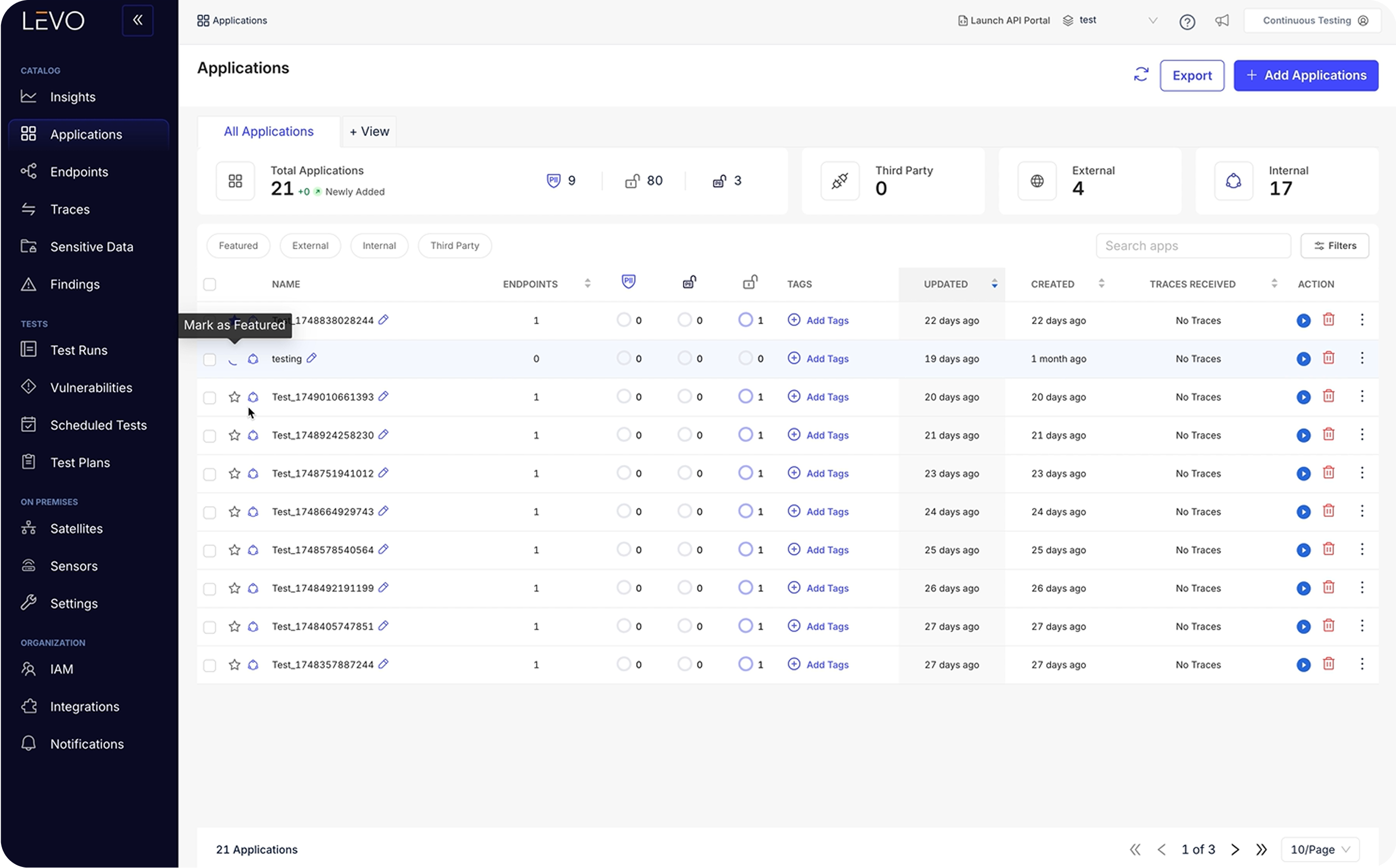
Gain complete visibility into every MCP server, plugin and tool call across your organisation. Levo inventories shadow servers, maps dependencies and surfaces who is accessing what, when and why to eliminate integration blind spots.

MCP Red Teaming
Continuously simulate real‑world attacks against your connectors to uncover prompt‑injection vectors, tool poisoning and misconfigured permissions before attackers exploit them. Red‑team findings feed directly into remediation workflows.
AI Threat Detection
Detect malicious patterns and abnormal tool behaviour, such as untrusted outputs, suspicious data flows or privilege‑escalation attempts in real time. Levo correlates model context, identity signals and server telemetry to stop attacks early.
MCP Governance
Define and enforce least‑privilege policies and session‑based RBAC, restrict tool arguments and outputs, and ensure every server and connector follows corporate and regulatory requirements. Maintain continuous audit logs for every tool call to support compliance.
.png)
MCP Blocking & Protection
Apply inline guardrails that redact PII/PHI from prompts and responses, block unauthorized commands and isolate compromised servers. Levo enforces encryption, authentication and version pinning to protect data and sustain operational resilience.
The value of secure MCP spans every enterprise team
Build and ship AI features faster with a universal connector while avoiding security bottlenecks. Simplify integration and accelerate innovation without having to become security experts.

Get complete visibility and control over MCP activity. Detect and block misuse, enforce policies and maintain detailed audit trails to meet internal risk posture and external compliance obligations.
Prove that your MCP deployments comply with privacy laws and industry regulations. Centralise governance, verify data access and reduce regulatory exposure.
Bring order to your AI integration landscape.

Frequently Asked Questions
Got questions? Go through the FAQs or get in touch with our team!
What is the Model Context Protocol (MCP) and why should enterprises care?
MCP is an open standard for connecting AI models to external tools and data sources. By standardising how models call plugins, it eliminates the M×N integration problem and accelerates AI innovation across vendors. However, universal connectors also broaden the attack surface; securing MCP servers is essential to protect sensitive data and maintain trust.
How is MCP different from traditional API integrations?
Traditional API gateways control network traffic, but they don’t understand prompts, model context or tool outputs. MCP allows AI to pass arbitrary natural‑language instructions to tools and retrieve rich responses. Securing MCP requires context‑aware monitoring, prompt filtering and runtime policies that go beyond conventional API security.
What are the top security threats to MCP servers?
Major risks include prompt‑injection attacks and tool poisoning, over‑privileged servers without proper authentication, identity drift from shared service accounts, data persistence that leaks PII/PHI, and supply‑chain vulnerabilities in open‑source connectors.
Can’t we just use our existing firewalls and API gateways for MCP Servers?
While essential, traditional tools can’t inspect or control AI prompts, context windows or tool outputs. MCP messages are semantic, not just network packets. Levo adds a model‑aware layer that understands prompts and responses, applies policies and detects misuse in real time, complementing your existing security stack.
Who should own MCP security?
Responsibility spans engineering, security and compliance. Engineering teams integrate MCP safely, security teams enforce visibility and protection, and compliance teams ensure that access and data flows meet regulatory requirements. A unified platform like Levo helps these stakeholders collaborate around a single source of truth.
How do we start securing MCP servers?
Begin with an inventory of all MCP servers and connectors. Implement least‑privilege credentials, mTLS and scoped RBAC. Apply policy filters to restrict inputs and outputs and enable audit logging for every tool call. Use Levo to monitor, red‑team and enforce policies across the lifecycle.
How does MCP security help with regulatory compliance?
Secure MCP deployments support documentation and evidence for audits, such as NAIC cybersecurity model rules and GDPR obligations. Levo generates detailed logs of tool calls, enforces data‑minimisation and consent policies, and helps prove that models do not leak sensitive data or make unfair decisions.
When is the right time to implement MCP security?
Security should be built in from the start. Even pilot projects need discovery, least‑privilege credentials and guardrails. Levo makes it easy to pilot safely and scale to new workflows without reopening security gaps.
What is the ROI of investing in MCP security?
Securing MCP reduces the likelihood of costly data breaches, fraud and compliance fines while preserving the agility benefits of universal connectors. Organisations report 30 % lower integration cost and 50–75 % faster development cycles when adopting MCP with proper controls.
How does Levo integrate with our existing MCP servers and tools?
Levo deploys alongside your MCP servers to discover and monitor all connectors. It uses API hooks and agentless sensors to enforce policies and feed telemetry into your SIEM and governance systems. Levo works with cloud‑hosted or self‑managed servers and supports any vendor‑agnostic connectors.
What best practices should we adopt for MCP security?
Use strong authentication and encryption; restrict privileges and isolate servers; pin connector versions and maintain SBOMs; log and monitor every tool call; and continuously red‑team and audit your environment. Levo’s platform automates many of these best practices.
How does MCP increase supply-chain and vendor risk?
Because MCP servers act as connectors to internal systems, any compromised or malicious third-party server can become a direct entry point into enterprise data.
Without governance, version control and code-integrity checks, enterprises risk inheriting vulnerabilities from open-source connectors or vendor-managed MCP servers.Can MCP expose sensitive internal data through context windows?
Yes. MCP unlocks AI access to files, records and tools, which can unintentionally push sensitive PII, PHI or IP into model context windows. Without guardrails and runtime policies, that data can be returned to end-users, logged by vendors or reused in unexpected model interactions, creating regulatory and reputational exposure.
What are the risks of “shadow MCP servers” inside large organizations?
Teams can spin up MCP servers without security review, leading to unmonitored data flows, unvalidated tools and over-privileged access paths. Shadow servers create blind spots that security teams cannot audit, opening the door to misconfigurations, accidental data exposure and increased attack surface.
How does securing MCP help enterprises scale AI safely?
Security-aligned MCP deployments provide unified visibility, standardised access controls and audit-ready records for every tool call. This allows engineering teams to ship AI features faster, while security and compliance teams maintain confidence that integrations are safe, governed and aligned with regulatory expectations.
How is sensitive data protected?
Gateways and firewalls see prompts and outputs at the edge. Levo sees the runtime mesh inside the enterprise, including agent to agent, agent to MCP, and MCP to API chains where real risk lives.
How is this different from model firewalls or gateways?
Live health and cost views by model and agent, latency and error rates, spend tracking, and detections for loops, retries, and runaway tasks to prevent outages and control costs.
What operational insights do we get?
Live health and cost views by model and agent, latency and error rates, spend tracking, and detections for loops, retries, and runaway tasks to prevent outages and control costs.
Does Levo find shadow AI?
Yes. Levo surfaces unsanctioned agents, LLM calls, and third-party AI services, making blind adoption impossible to miss.
Which environments are supported?
Levo covers LLMs, MCP servers, agents, AI apps, and LLM apps across hybrid and multi cloud footprints.
What is Capability and Destination Mapping?
Levo catalogs agent tools, exposed schemas, and data destinations, translating opaque agent behavior into governable workflows and early warnings for risky data paths.
How does this help each team?
Engineering ships without added toil, Security replaces blind spots with full runtime traces and policy enforcement points, Compliance gets continuous evidence that controls work in production.
How does Runtime AI Visibility relate to the rest of Levo?
Visibility is the foundation. You can add AI Monitoring and Governance, AI Threat Detection, AI Attack Protection, and AI Red Teaming to enforce policies and continuously test with runtime truth.
Will this integrate with our existing stack?
Yes. Levo is designed to complement existing IAM, SIEM, data security, and cloud tooling, filling the runtime gaps those tools cannot see.
What problems does this prevent in practice?
Prompt and tool injection, over permissioned agents, PHI or PII leaks in prompts and embeddings, region or vendor violations, and cascades from unsafe chained actions.
How does this unlock faster AI adoption?
Levo provides the visibility, attribution, and audit grade evidence boards and regulators require, so CISOs can green light production and the business can scale AI with confidence.
What is the core value in one line?
Unlock AI ROI with rapid, secure rollouts in production, powered by runtime visibility across your entire AI control plane.
Show more