AI Security for Retail


%20(1).png)







AI is Transforming Retail
and Expanding the Attack Surface

Fraudsters are using generative AI to create synthetic identities, craft phishing emails and operate bots that behave like real shoppers. Losses to online payment fraud are forecasted to be $107 billion by 2029 as deepfakes and “friendly fraud” erode margins. Without runtime controls, AI applications can unwittingly aid these attacks.

AI models embedded in recommendation engines and voice assistants increasingly interact with payment flows and point‑of‑sale (POS) terminals. AI systems that memorize payment tokens or inadvertently reveal cardholder data invite fines and breaches.

Shoppers now buy through web, mobile apps, social platforms and voice assistants. Promotion engines and loyalty programs powered by AI become targets for account takeover, reward abuse and cross‑channel credential stuffing.

AI‑driven recommendation and dynamic pricing engines analyze purchase history, real‑time behavior and demographic data. Without proper masking and governance, these models may expose personally identifiable information (PII) or profile shoppers in ways that violate privacy laws.

Modern stores use AI for foot-traffic heatmaps, loss-prevention vision models, and behavioral analytics. When compromised, AI models may misclassify shoplifting, alter staffing decisions, or leak sensitive operational insights.

Attackers now use AI bots to test thousands of discount codes, emulate high-value loyalty accounts, or exploit reward redemptions at scale. Because these journeys are language-driven and context-dependent, traditional fraud systems often miss them, leading to margin erosion, inventory distortion, and customer trust issues.

Levo AI Security Platform for Retail
Runtime AI Visibility
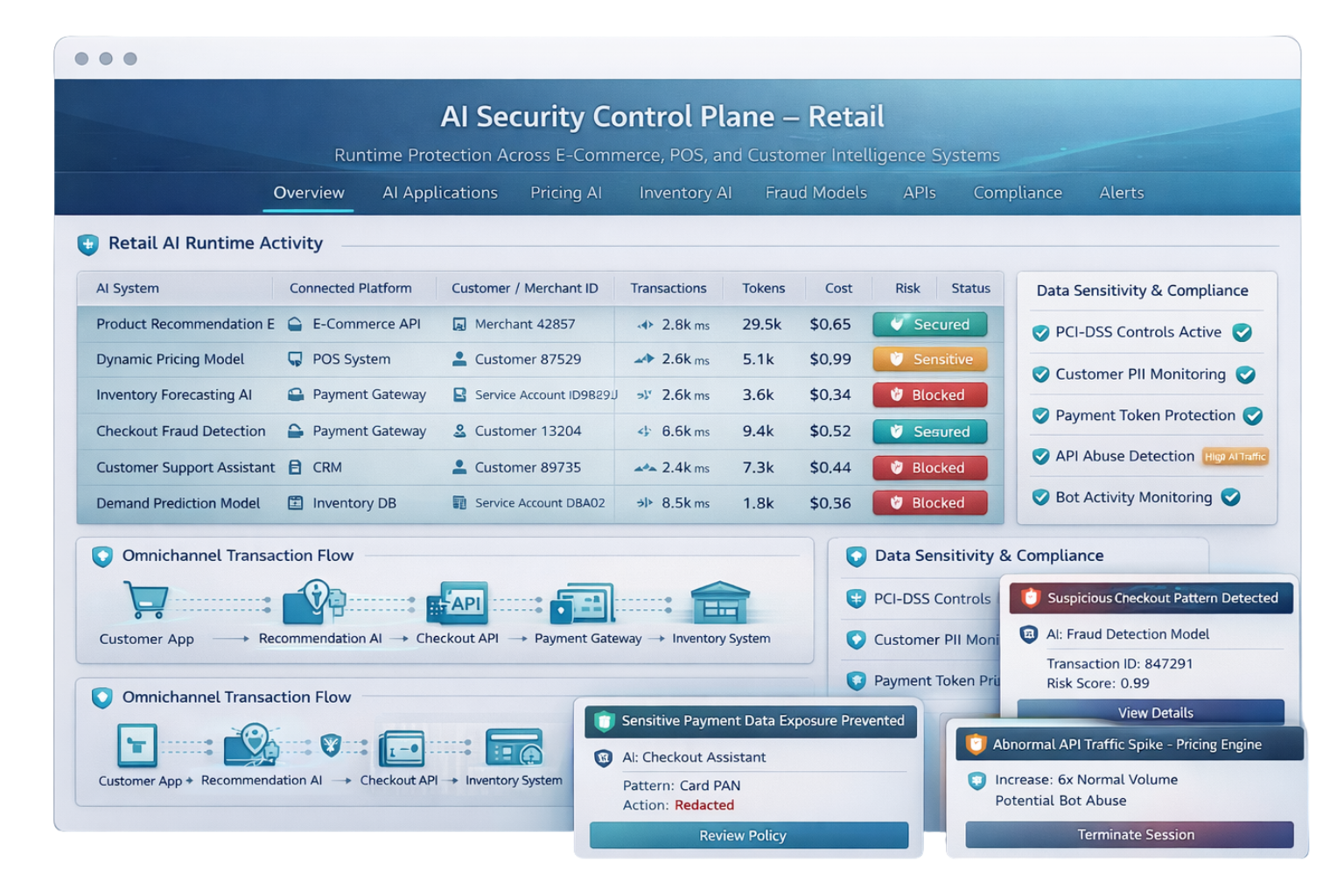
Continuously maps AI workflows across ecommerce sites, mobile apps, POS systems, loyalty programs and inventory services. See which models are used, what data they access and how they interact with payment gateways in real time.

AI Monitoring & Governance
Tracks model performance, error rates, false positives and abusive patterns across fraud‑scoring engines, pricing algorithms and customer‑support bots. Alerts teams when behavior drifts or violates business rules.
AI Threat Detection
Detects AI‑driven bots, account‑takeover attempts, promo abuse and anomalous POS activity by inspecting prompts, API calls and data flows. Flags deepfake‑driven verification bypasses and synthetic‑identity fraud before they succeed.
AI Threat Protection
Enforces policies on PII, payment tokens and loyalty data. Blocks prompt injections and leaks in real time, redacts sensitive content from model inputs/outputs and ensures only authorized systems can call high‑risk APIs.
.png)
AI Red Teaming
Continuously tests fraud models, chatbots and recommendation engines against adversarial prompts and attack simulations tailored for retail. Helps teams harden models against refund abuse, BNPL exploitation and inventory manipulation.
Built for Retail’s Key Stakeholders

Deliver personalized shopping, dynamic pricing and inventory automation faster without constant security reviews. Levo’s guardrails reduce fraud and compliance rework so teams can focus on innovation.

Gain unified visibility into AI‑driven fraud scores, payment flows and IoT devices across stores and ecommerce sites. Apply least‑privilege policies, detect abuse and enforce PCI‑DSS controls from a single platform.

Demonstrate adherence to PCI DSS, GDPR, CCPA and emerging AI regulations. Automated logging and audit trails simplify assessments, while built‑in redaction and encryption help preserve shopper privacy.
Secure your AI‑powered retail operations today.

Frequently Asked Questions
Got questions? Go through the FAQs or get in touch with our team!
What is AI Security for Retail?
It is the set of tools and controls that secure AI models across retail functions: ecommerce websites, mobile apps, POS systems, APIs and IoT, while maintaining customer experience. AI Security for Retail protects cardholder data, shopper identities and proprietary business logic from AI‑driven threats like synthetic‑identity fraud, prompt injection and data leakage
How are retailers using AI today?
Retailers deploy AI for personalized recommendations and dynamic pricing, demand forecasting and inventory optimization, chatbots and visual search, fraud detection and logistics. These models analyze purchase history, real‑time behavior and market data to enhance conversion and efficiency.
What are the biggest risks of AI in ecommerce and payments?
AI is supercharging fraud: merchants are concerned about synthetic identities, deepfake‑powered verification bypasses and bot‑driven account takeovers. Juniper Research forecasts online payment fraud losses rising from $44.3 billion in 2024 to $107 billion by 2029. Models can also memorize or expose payment tokens, creating PCI DSS violations if not properly secured.
How does omnichannel expansion widen the attack surface?
Consumers shop through websites, mobile apps, social media, marketplaces and voice assistants. Each channel introduces different vulnerabilities, and attackers exploit unsecured APIs and inconsistent security protocols. AI‑powered loyalty programs and promotion engines can be abused through account takeover and coupon fraud, so end‑to‑end policies must follow the customer across every touchpoint.
Why are IoT devices and in‑store AI a security concern?
Smart shelves, cameras, RFID tags and predictive‑maintenance sensors are proliferating; the retail IoT market is worth $42.5 billion in 2022 and is growing nearly 28.5 % annually. Each device connected to operational technology networks is a new entry point for attackers, and 75 % of OT organizations report at least one intrusion per year. Compromised IoT data can mislead AI models and disrupt store operations.
What does PCI DSS say about using AI in payment environments?
The PCI Security Standards Council warns that deploying AI does not eliminate PCI obligations. AI systems must be implemented in accordance with PCI DSS, including securing cardholder data as it is stored, processed and transmitted. Models should not be trusted with high‑impact secrets or unprotected sensitive data. Logging, monitoring and human oversight are required throughout the AI lifecycle.
How can retailers reduce AI‑powered fraud without degrading user experience?
Combating AI fraud requires AI‑vs‑AI defenses. Merchants are investing in real‑time behavior analytics and pattern recognition to detect synthetic identities and bots. Levo augments existing fraud engines by inspecting prompts and outputs, enforcing policies on personal data and payment tokens, and blocking malicious requests before they complete, keeping checkout seamless for legitimate shoppers.
What best practices should we follow when building AI models for retail?
Limit the sensitive data fed into models; sanitize training data to remove API tokens, credentials and cardholder information. Apply least‑privilege access to AI systems and ensure humans remain in the loop. Log and monitor all model actions and continuously test them for drift and vulnerabilities. Validate models prior to deployment and throughout their lifecycle to account for non‑deterministic outputs and supply‑chain risk.
How does Levo integrate with existing retail systems?
Levo provides lightweight sensors that integrate with ecommerce platforms, payment gateways, POS providers, fraud engines, loyalty systems and IoT management platforms. It observes prompts and responses without interfering with transaction flow, and enforces policies via in‑line proxies or SDKs. Pre‑built connectors for leading retail and payment platforms accelerate deployment.
What ROI can we expect from AI Security for Retail?
Investing in AI security reduces fraud losses, which now cost U.S. firms more than four dollars for every dollar lost, and helps avoid PCI fines and reputational damage. It also accelerates approval of AI initiatives by satisfying security and compliance requirements, enabling faster time to market. By preventing data leaks and bot abuse, retailers preserve customer trust and unlock the full revenue potential of personalization and automation.
Is AI Security relevant for small and midsize retailers?
Yes. Fraud and compliance risks are not confined to enterprise retailers; small and midsize businesses often lack the resources to detect sophisticated AI‑enabled attacks. Cloud‑based AI security platforms like Levo provide turnkey protection and monitoring that scales with the business and integrates with popular ecommerce platforms.
How is sensitive data protected?
Gateways and firewalls see prompts and outputs at the edge. Levo sees the runtime mesh inside the enterprise, including agent to agent, agent to MCP, and MCP to API chains where real risk lives.
How is this different from model firewalls or gateways?
Live health and cost views by model and agent, latency and error rates, spend tracking, and detections for loops, retries, and runaway tasks to prevent outages and control costs.
What operational insights do we get?
Live health and cost views by model and agent, latency and error rates, spend tracking, and detections for loops, retries, and runaway tasks to prevent outages and control costs.
Does Levo find shadow AI?
Yes. Levo surfaces unsanctioned agents, LLM calls, and third-party AI services, making blind adoption impossible to miss.
Which environments are supported?
Levo covers LLMs, MCP servers, agents, AI apps, and LLM apps across hybrid and multi cloud footprints.
What is Capability and Destination Mapping?
Levo catalogs agent tools, exposed schemas, and data destinations, translating opaque agent behavior into governable workflows and early warnings for risky data paths.
How does this help each team?
Engineering ships without added toil, Security replaces blind spots with full runtime traces and policy enforcement points, Compliance gets continuous evidence that controls work in production.
How does Runtime AI Visibility relate to the rest of Levo?
Visibility is the foundation. You can add AI Monitoring and Governance, AI Threat Detection, AI Attack Protection, and AI Red Teaming to enforce policies and continuously test with runtime truth.
Will this integrate with our existing stack?
Yes. Levo is designed to complement existing IAM, SIEM, data security, and cloud tooling, filling the runtime gaps those tools cannot see.
What problems does this prevent in practice?
Prompt and tool injection, over permissioned agents, PHI or PII leaks in prompts and embeddings, region or vendor violations, and cascades from unsafe chained actions.
How does this unlock faster AI adoption?
Levo provides the visibility, attribution, and audit grade evidence boards and regulators require, so CISOs can green light production and the business can scale AI with confidence.
What is the core value in one line?
Unlock AI ROI with rapid, secure rollouts in production, powered by runtime visibility across your entire AI control plane.
Show more