AI Security for Secure, Compliant Healthcare AI
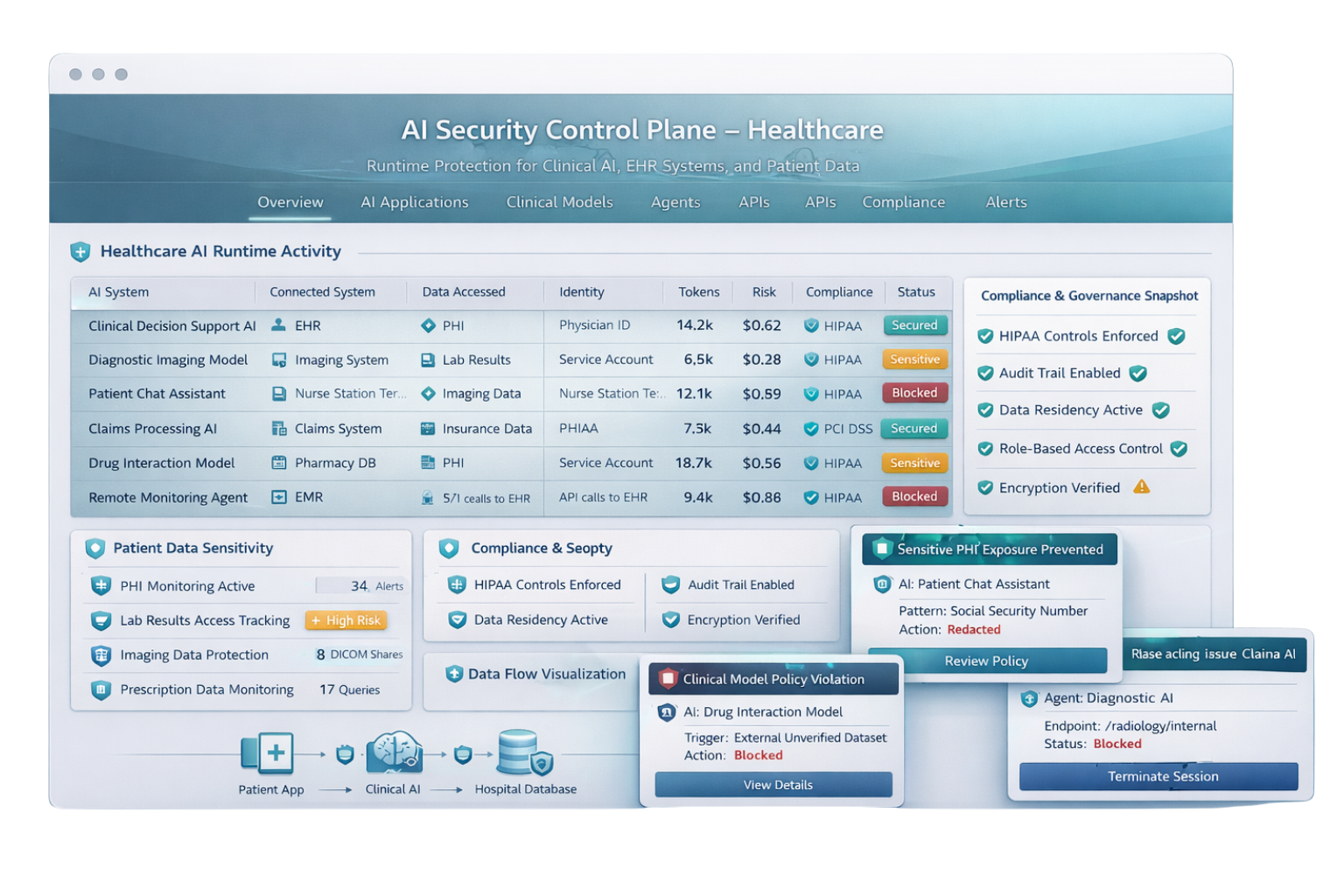

%20(1).png)







AI That Elevates Patient Experience
Can Erode It If Left Unprotected

AI scribes, chatbots, and assistants can leak patient data into non-compliant systems. LLMs that aren’t governed or HIPAA-aligned create silent PHI spillover across care settings.

External AI vendors, tools, and APIs introduce new pathways for sensitive data to move and accumulate. Every unmonitored integration increases exposure risk as PHI flows beyond your governed systems.

Hallucinated summaries and missing clinical details become patient-safety events in high-stakes workflows. Non-deterministic outputs can distort documentation, recommendations, or patient communication.

Misclassifications and model failures inside connected devices can trigger diagnostic or monitoring errors. Recent recalls show how AI inconsistencies directly escalate into patient-harm scenarios.

Prompts, inputs, and user queries can be manipulated to extract regulated or sensitive information. LLMs enable adversarial behavior without traditional security signals or authentication cues.

HIPAA, Joint Commission, and FDA expectations now demand AI-specific controls and evidence of governance.Legacy cybersecurity cannot prove safe, compliant, and auditable model behavior across workflows.

Secure Every AI Workflow in Healthcare
AI Automatically & Continuously
Runtime AI Visibility
Gain real-time visibility into how AI tools, assistants, and models interact with PHI across clinical and operational workflows.
Track prompts, outputs, data flows, and decisions so healthcare teams can see exactly how AI is behaving inside and outside the EHR.

AI Monitoring & Governance
Continuously monitor AI behavior to ensure safe, compliant, and policy-aligned use of PHI and clinical data. Establish guardrails, enforce policies, and operationalize AI governance frameworks required by HIPAA, Joint Commission, and internal risk teams.
AI Threat Detection
Detect jailbreaks, prompt manipulation, data extraction attempts, and unsafe model behavior in real time. Healthcare teams get early warnings when inputs or outputs could expose PHI, generate unsafe content, or violate security and compliance rules.
AI Threat Protection
Automatically block unsafe prompts, responses, and data flows before they reach patients, clinicians, or downstream systems. Levo’s enforcement layer prevents PHI leakage, disallowed actions, and malicious manipulation, without disrupting clinician or patient-facing workflows.
.png)
AI Red Teaming
Continuously stress-test AI assistants, clinical copilots, chatbots, and models against realistic attack scenarios. Identify vulnerabilities before they impact patient safety or PHI, and generate evidence needed for audits, HIPAA reviews, and internal governance boards.
Built for Every Leader Driving Healthcare AI
Ship AI faster and with confidence, from clinical assistants to operational automation, without adding security bottlenecks. Levo gives engineering, EHR, and digital teams the visibility and guardrails needed to safely scale AI across care delivery, operations, and patient experience.

Regain control over AI usage across the health system, even when teams are rapidly adopting new tools. Levo provides runtime oversight, PHI-specific enforcement so security teams can manage AI risk without slowing innovation.
Prove HIPAA alignment, PHI protection, and continuous oversight of AI behavior. Levo offers audit-ready evidence, policy enforcement, and monitoring so compliance teams can approve AI initiatives with confidence.
Integrate Secure, Compliant AI to Healthcare Applications

Frequently Asked Questions
Got questions? Go through the FAQs or get in touch with our team!
Is it HIPAA-compliant to use AI assistants or LLM tools with PHI?
It depends. Public LLMs cannot process PHI unless the vendor signs a BAA and implements strict HIPAA-required safeguards such as encryption, access controls, and auditability. Even with a BAA, hospitals must enforce runtime controls to prevent PHI leakage, unexpected retention, or cross-context inference by the model. Safe usage means establishing monitored, governed, and compliant AI workflows for every model interaction, rather than trusting the model by default.
How do hospitals secure EHR-integrated AI assistants and clinical LLM tools?
EHR-integrated AI tools require controls around prompts, outputs, and downstream use, not just the EHR connection itself. Hospitals need real-time monitoring to ensure models never surface PHI inappropriately, distort clinical notes, or generate unsafe recommendations. This requires a security layer between the EHR, the model, and the user workflow to validate every AI interaction and produce audit-ready evidence for internal and regulatory review.
What’s the difference between traditional healthcare cybersecurity and AI security?
Traditional cybersecurity protects infrastructure: networks, endpoints, devices, and identity systems. AI security protects model behavior: the logic that governs prompts, outputs, decisions, and data movement. AI introduces natural-language attack surfaces, unpredictable reasoning pathways, and PHI exposure vectors that firewalls and DLP tools cannot interpret. Healthcare organizations now need a behavioral control plane to govern how AI systems operate in regulated clinical environments.
Can hospitals use public generative AI tools safely?
Not with PHI. Public LLMs may retain data, reuse it for training, or generate outputs that inadvertently reveal sensitive details. Even “de-identified” text may re-identify patients when paired with clinical context. Safe usage requires PHI redaction, strict policy enforcement, and runtime monitoring to ensure that no protected data reaches public models and that no unsafe output flows back into patient communication or clinical documentation.
How does AI security support HIPAA, HITECH, and Joint Commission audits?
AI security provides continuous, audit-ready evidence of how PHI is processed, how decisions are made, and how policies are enforced during AI interactions. This includes logs of model behavior, records of blocked or redacted content, and documentation of safe PHI handling. Such artifacts directly support HIPAA’s Privacy and Security Rule obligations and HITECH’s heightened enforcement penalties. They also meet Joint Commission expectations for demonstrating safe and governed use of AI in clinical settings.
Can AI monitoring help identify unsafe or biased clinical outputs?
Yes. AI monitoring evaluates how models behave across different input types, detecting patterns associated with unsafe recommendations, biased outputs, or reasoning errors. It also flags anomalous behavior caused by data drift, adversarial inputs, or misaligned model configurations. Clinical governance teams can then intervene early: before these issues affect patient outcomes, equity standards, or accreditation requirements.
How do we secure AI models used in medical imaging, diagnostics, or clinical decision support?
Diagnostic AI must be continuously evaluated for performance drift, input anomalies, and inconsistent recommendations. Security controls help detect when models behave unpredictably or expose PHI embedded in imaging metadata or associated files. Hospitals also need behavioral monitoring to catch adversarial manipulation of medical images, which can subtly distort outputs. This protects patient safety and supports regulatory expectations as diagnostic AI becomes part of clinical care pathways.
How does AI affect third-party and vendor risk?
Every AI vendor introduces new, often invisible data pipelines where PHI can move, be stored, or processed without adequate controls. Traditional vendor risk programs do not account for model behavior, prompt manipulation, or probabilistic outputs that may leak sensitive data. As AI adoption expands, the blast radius of misconfigurations and vendor misuse grows dramatically. Hospitals need visibility, enforcement, and auditability across every AI integration, not just signed BAAs.
How do hospitals secure API-based AI integrations with vendors?
Every AI-connected API creates a new PHI pathway, and hospitals cannot rely solely on vendor assurances. Real-time visibility is needed to track exactly what data is sent to each model and what comes back. Policy enforcement must block disallowed fields, identifiers, or sensitive patterns before data leaves the hospital’s environment. This approach strengthens BAA compliance and closes gaps left by static vendor questionnaires or one-time due diligence.
What does “AI governance” actually mean for healthcare organizations?
AI governance refers to the continuous oversight of how AI systems handle PHI, make decisions, and influence clinical or operational processes. It includes access controls, safety monitoring, bias detection, audit logging, and documentation of every model interaction. Regulators now expect hospitals to show evidence of governance, not one-time approvals, especially as AI is embedded in EHRs, clinical decision tools, and patient-facing systems. Effective governance requires a centralized, monitored AI control layer.
Are AI-enabled medical devices a cybersecurity or clinical safety issue?
Both. AI-driven devices can misclassify signals, produce inconsistent results across demographic groups, or respond unpredictably to adversarial inputs. When these outputs directly affect diagnosis, monitoring, or treatment pathways, the risk shifts from technical failure to patient harm. Continuous monitoring, validation, and behavior-level enforcement are necessary to ensure devices remain safe, reliable, and aligned with regulatory expectations for clinical-grade AI performance.
How can we protect PHI when using AI for patient communication or triage?
Patient-facing AI tools often process sensitive information in real time, which makes PHI protection essential. Hospitals must use pre-processing safeguards (automatic PHI detection and redaction), policy enforcement (blocking disallowed identifiers), and monitoring (flagging unsafe outputs) to keep patient data within controlled environments. AI-specific oversight ensures that triage bots, symptom checkers, and communication tools do not disclose PHI to external vendors or generate unsafe or misleading medical guidance.
What security controls are needed for AI used in EHR documentation and coding?
AI documentation tools must be supervised to prevent prompt misuse, hallucinations, omissions, or accidental PHI transformation. Real-time monitoring ensures models do not alter clinical meaning or introduce fabricated details into the patient record. Policy enforcement prevents sensitive identifiers from leaving the EHR boundary or being passed to third-party models. These controls keep AI-assisted documentation compliant, accurate, and safe for both clinical and billing workflows.
Do AI-powered scheduling, billing, or RCM tools create PHI risks?
Yes. Administrative automation tools often process PHI, including demographic data, insurance details, account numbers, and claim histories. Without AI-specific monitoring, these workflows may transfer or infer sensitive data outside controlled systems, creating compliance blind spots. A security layer prevents unauthorized data movement, enforces policy boundaries, and ensures that efficiency gains do not come at the cost of privacy exposure or financial risk.
How does AI security fit into healthcare cybersecurity frameworks like Zero Trust?
Zero Trust requires verifying every request, action, and user, and the same must apply to AI models. AI security adds behavioral verification by inspecting every prompt, output, and model interaction for PHI handling, policy adherence, and safety compliance. This extends Zero Trust protections into AI-powered clinical workflows, patient communication tools, and vendor integrations. Hospitals gain a unified security posture in which nothing and no model is implicitly trusted.
How is sensitive data protected?
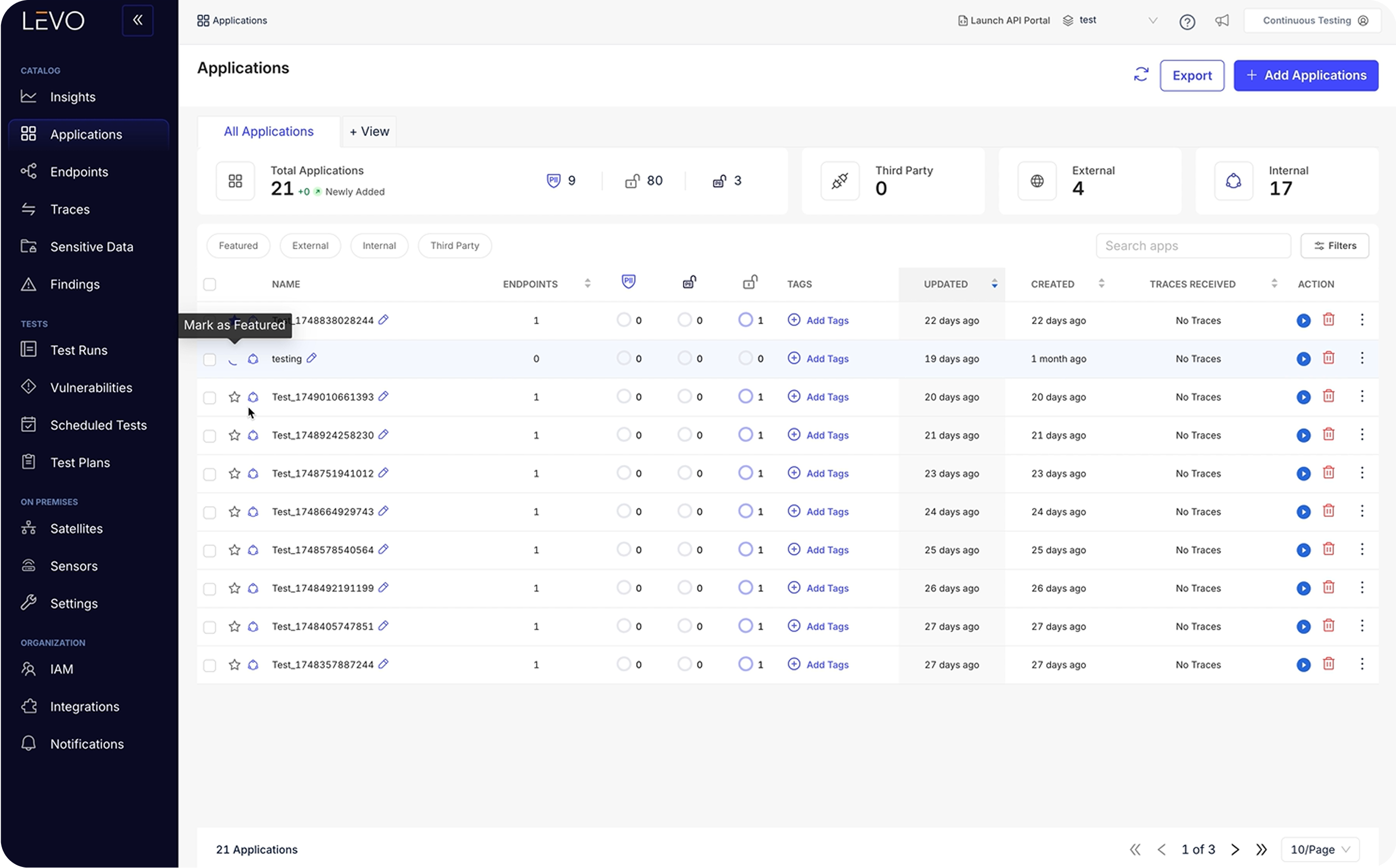
Gateways and firewalls see prompts and outputs at the edge. Levo sees the runtime mesh inside the enterprise, including agent to agent, agent to MCP, and MCP to API chains where real risk lives.
How is this different from model firewalls or gateways?
Live health and cost views by model and agent, latency and error rates, spend tracking, and detections for loops, retries, and runaway tasks to prevent outages and control costs.
What operational insights do we get?
Live health and cost views by model and agent, latency and error rates, spend tracking, and detections for loops, retries, and runaway tasks to prevent outages and control costs.
Does Levo find shadow AI?
Yes. Levo surfaces unsanctioned agents, LLM calls, and third-party AI services, making blind adoption impossible to miss.
Which environments are supported?
Levo covers LLMs, MCP servers, agents, AI apps, and LLM apps across hybrid and multi cloud footprints.
What is Capability and Destination Mapping?
Levo catalogs agent tools, exposed schemas, and data destinations, translating opaque agent behavior into governable workflows and early warnings for risky data paths.
How does this help each team?
Engineering ships without added toil, Security replaces blind spots with full runtime traces and policy enforcement points, Compliance gets continuous evidence that controls work in production.
How does Runtime AI Visibility relate to the rest of Levo?
Visibility is the foundation. You can add AI Monitoring and Governance, AI Threat Detection, AI Attack Protection, and AI Red Teaming to enforce policies and continuously test with runtime truth.
Will this integrate with our existing stack?
Yes. Levo is designed to complement existing IAM, SIEM, data security, and cloud tooling, filling the runtime gaps those tools cannot see.
What problems does this prevent in practice?
Prompt and tool injection, over permissioned agents, PHI or PII leaks in prompts and embeddings, region or vendor violations, and cascades from unsafe chained actions.
How does this unlock faster AI adoption?
Levo provides the visibility, attribution, and audit grade evidence boards and regulators require, so CISOs can green light production and the business can scale AI with confidence.
What is the core value in one line?
Unlock AI ROI with rapid, secure rollouts in production, powered by runtime visibility across your entire AI control plane.
Show more