Unlock Business Value from LLMs Without the Security Risks


%20(1).png)







What Makes LLMs Powerful Also Makes Them Dangerous
.svg)
Attackers use crafty inputs or hidden instructions to override model guardrails. Without controls, an LLM may execute unauthorized actions or leak information, putting customer trust and brand reputation at stake.

LLMs trained on proprietary data can regurgitate secrets or personal information. Exposure of IP, PII or regulated data can trigger fines and undermine customer loyalty.

Models sometimes fabricate information or generate toxic content. Over‑reliance on unverified outputs can drive poor business decisions and harm customer experience.

Using external APIs or open‑source models introduces vendor risk; compromised plugins or model files can introduce backdoors. Security leaders must ensure that both in‑house and third‑party LLMs follow best practices.

Fine‑tuning or RAG pipelines using unvetted data may plant hidden vulnerabilities or bias. Without sanitization, models can behave unpredictably or be manipulated.

Building RAG involves vector databases, embedding models and orchestration across agents and LLMs. Many enterprises lack the expertise to deploy and secure these components at scale.

LLM Security to retain LLM powered Accelerated
Prompt & Output Guardrails
Levo filters user inputs and model outputs in real time to block jailbreaks, prompt misuse, hallucinations, and toxic content. These adaptive, model-agnostic guardrails ensure safe interactions across use cases.

Data Protection & Leakage Prevention
Levo detects and redacts sensitive data like PII, PHI, and secrets in both directions, keeping prompts and responses compliant. This safeguards enterprise IP and reduces exposure across third-party models.
LLM Policy Enforcement at Runtime
Define behavioral rules and content policies in code, then let Levo enforce them in real time. Whether it's banning specific tools, geographies, or model types, you stay in control of how LLMs operate.
LLM Monitoring and Risk Analytics
Levo continuously monitors for behavioral drift, tool abuse, and abnormal activity. Teams get real-time alerts and deep audit logs to investigate issues before they escalate.
.png)
Red Team Testing for LLM Security
Levo red-teams your models in staging with adversarial prompts and long payloads, improving defenses before deployment. This helps security teams evolve protection as threats evolve.
LLM Security that helps Enterprise Teams Ship Secure LLMs at Scale
With Levo, engineering teams can integrate and scale LLMs without expanding security risk. They benefit from the delivery speed, user experience, and market edge of GenAI, without being blocked by security concerns.

Levo enables security teams to defend complex LLM attack surfaces without scaling headcount. With AI-aware guardrails and automation, leaner teams can secure more ground, as security budgets never evolve in sync with attack surface.
Levo addresses key compliance concerns upfront, from data minimization to audit logging, so regulatory success isn’t left to chance. Teams can prove policy enforcement across models, vendors, and user interactions.
Ship LLMs Fast. Without Security Blind Spots.

Frequently Asked Questions
Got questions? Go through the FAQs or get in touch with our team!
What is LLM security and why does it matter for enterprises?
LLM security refers to the practices, tools, and policies that protect Large Language Model (LLM) applications from threats like prompt injection, data leakage, and misuse. It’s critical for enterprises because LLMs process sensitive inputs and generate outputs in unpredictable ways, making them uniquely vulnerable compared to traditional software .
Why are traditional application security tools not enough for LLMs?
Traditional AppSec tools rely on deterministic code paths and structured inputs. LLMs, by contrast, interpret natural language and operate probabilistically, meaning static scanning and rule-based validation often fail to catch LLM-specific threats like jailbreaking or hallucinated responses .
What are the biggest security risks of deploying LLMs in enterprise environments?
Top risks include prompt injection attacks, sensitive data leakage, hallucinated or toxic outputs, supply-chain vulnerabilities, and compliance failures. Because LLMs operate on unpredictable, user-provided content, they’re harder to defend using traditional techniques .
Why are prompt injections a growing concern in LLM-based applications?
Prompt injections exploit the model's sensitivity to input phrasing, allowing attackers to override instructions, access restricted data, or trigger unauthorized actions. As more applications rely on user inputs for dynamic LLM tasks, the attack surface continues to grow .
How do LLMs expose sensitive data or intellectual property?
LLMs may memorize sensitive training data and regurgitate it in responses. They can also process and expose confidential inputs (like IP, PII, or secrets) without appropriate controls, especially when interacting with third-party APIs or external plugins.
How does Levo help prevent prompt injection and jailbreak attacks?
Levo sits in front of LLMs and filters prompts in real time, detecting malicious patterns like obfuscated instructions or indirect jailbreak attempts. It enforces structure and rewrites unsafe input, blocking attacks while preserving legitimate use .
How does Levo secure proprietary and sensitive data used with LLMs?
Levo uses integrated DLP techniques to scan and redact PII, PHI, credentials, and other confidential info in both prompts and responses. It enforces policy before data reaches the model and masks it in returned outputs .
What kind of runtime monitoring does Levo offer for LLM behavior?
Levo continuously logs prompts, responses, tool invocations, and user actions. It applies risk scoring and anomaly detection to highlight unusual behavior, providing visibility for security and compliance teams .
How does Levo support compliance with GDPR, HIPAA, and other regulations?
Levo enforces data minimization, redaction, policy-based routing, and keeps tamper-proof audit logs. This allows teams to demonstrate regulatory alignment, respond to subject access requests, and prevent unauthorized data retention .
Can Levo secure both third-party APIs and custom fine-tuned LLMs?
Yes, Levo works across architectures. It supports both externally hosted APIs (like OpenAI) and in-house models, including fine-tuned or RAG-enabled LLMs. It enforces guardrails agnostic of model or vendor .
How can enterprises integrate LLM security without slowing down deployment?
Levo offers end-to-end security support that ensures secure development in earlier stages of SDLC and complete runtime security within production. This lets teams scale secure deployments without slowing down engineering velocity .
What are best practices for securing LLM Applications?
Secure apps follow principles like strict input/output filtering, sandboxing tool access, least privilege controls, red-teaming before deployment, and continuous monitoring. These are designed to treat both input and model output as untrusted by default .
How does Levo support anomaly detection and risk scoring for LLMs?
Levo assigns dynamic risk scores based on behavioral patterns like excessive token usage, unexpected tool calls, or prompt structure anomalies. It flags divergences from expected use and enables intervention before risks escalate .
How does Levo support end-to-end security for LLM applications?
Levo secures the entire lifecycle, from sanitizing training data, validating prompts at runtime, enforcing output filters, to audit logging and red-teaming. This covers ingestion to output and supports CI/CD pipelines for LLMs .
Can Levo scale with multi-model or multi-vendor AI deployments?
Yes. Levo is model-agnostic and supports multiple vendors, including open-source and closed-source LLMs. It enables consistent guardrails and unified monitoring across varied deployments, ensuring scalability and interoperability .
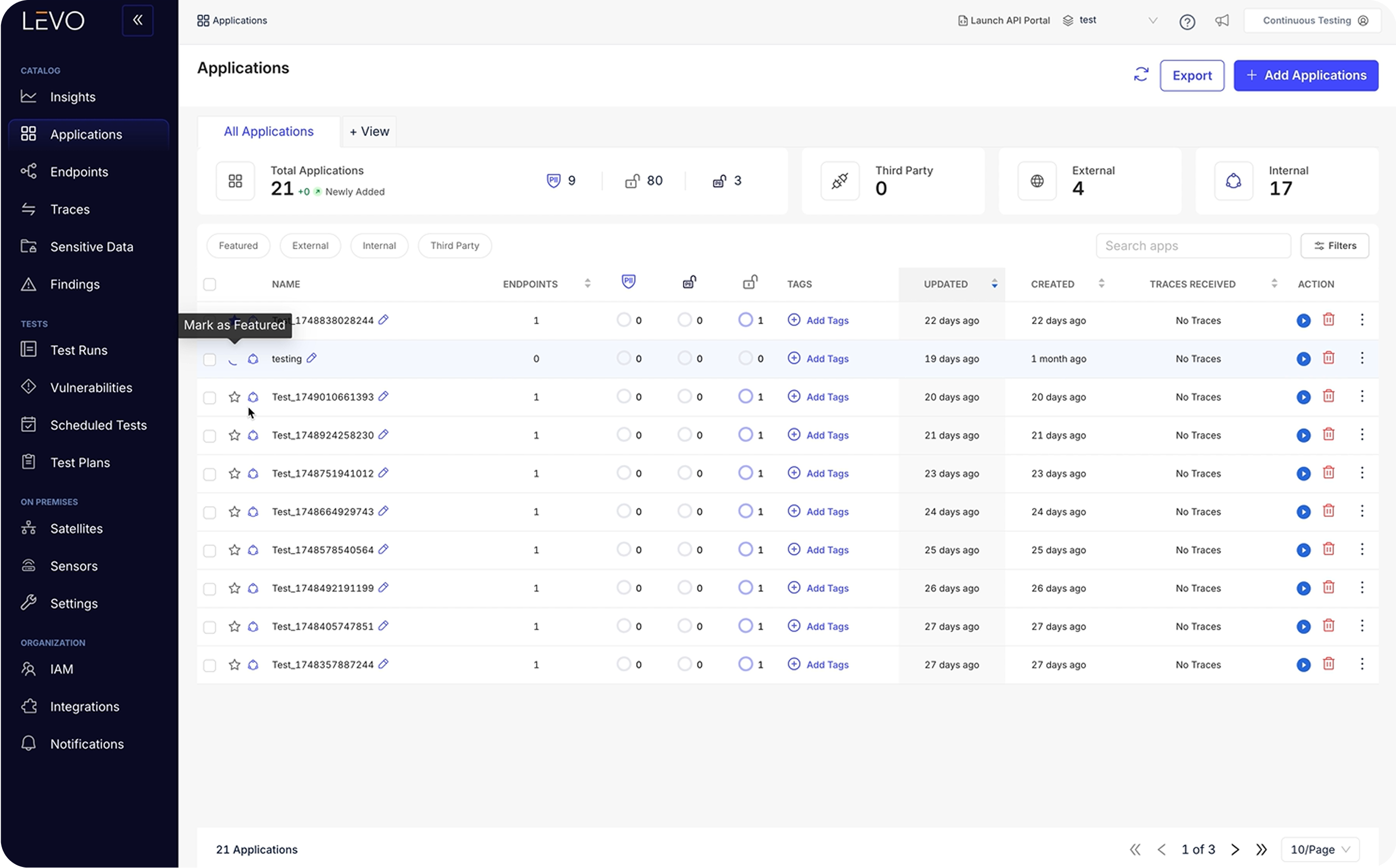
How is sensitive data protected?
Gateways and firewalls see prompts and outputs at the edge. Levo sees the runtime mesh inside the enterprise, including agent to agent, agent to MCP, and MCP to API chains where real risk lives.
How is this different from model firewalls or gateways?
Live health and cost views by model and agent, latency and error rates, spend tracking, and detections for loops, retries, and runaway tasks to prevent outages and control costs.
What operational insights do we get?
Live health and cost views by model and agent, latency and error rates, spend tracking, and detections for loops, retries, and runaway tasks to prevent outages and control costs.
Does Levo find shadow AI?
Yes. Levo surfaces unsanctioned agents, LLM calls, and third-party AI services, making blind adoption impossible to miss.
Which environments are supported?
Levo covers LLMs, MCP servers, agents, AI apps, and LLM apps across hybrid and multi cloud footprints.
What is Capability and Destination Mapping?
Levo catalogs agent tools, exposed schemas, and data destinations, translating opaque agent behavior into governable workflows and early warnings for risky data paths.
How does this help each team?
Engineering ships without added toil, Security replaces blind spots with full runtime traces and policy enforcement points, Compliance gets continuous evidence that controls work in production.
How does Runtime AI Visibility relate to the rest of Levo?
Visibility is the foundation. You can add AI Monitoring and Governance, AI Threat Detection, AI Attack Protection, and AI Red Teaming to enforce policies and continuously test with runtime truth.
Will this integrate with our existing stack?
Yes. Levo is designed to complement existing IAM, SIEM, data security, and cloud tooling, filling the runtime gaps those tools cannot see.
What problems does this prevent in practice?
Prompt and tool injection, over permissioned agents, PHI or PII leaks in prompts and embeddings, region or vendor violations, and cascades from unsafe chained actions.
How does this unlock faster AI adoption?
Levo provides the visibility, attribution, and audit grade evidence boards and regulators require, so CISOs can green light production and the business can scale AI with confidence.
What is the core value in one line?
Unlock AI ROI with rapid, secure rollouts in production, powered by runtime visibility across your entire AI control plane.
Show more